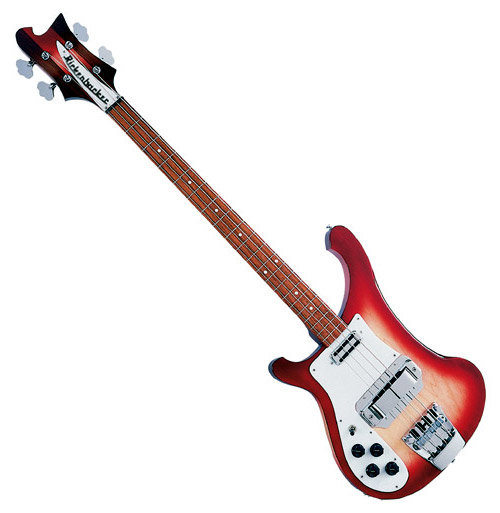
This is similiar to Paul McCartney's
Rickenbacker 4001S Bass Guitar
Most used during 1966 through 1968
The electric bass guitar has it's origins in the invention of the upright double bass. The double bass was used during the baroque period through modern times in what is now called classical music, as well as in the world of jazz. The first move toward purely electrically amplified instruments was the electric "Hawaiian guitar", a solo instrument played with a metal slide. The first production of these guitars with magnetic pickups was in 1931 by the Electro Sinng Company.
Soon after, the Gibson company began manufacturing electro-acoustic guitars. These instruments had hollow bodies with a magnetic pick-up. Les Paul, world famous guitarist, used Epiphone's workshop to make the first solid body electric guitar in 1941. These instruments were relegated to the rhythm section of jazz bands and never associated with so-called "solo" instruments.
Upright bass players added pickups to their instruments, too. However, it was not until 1950 until Leo Fender realized the acoustical problems associated with placing pickups on stand-up basses and manage playing of upright basses with pickups that he invented the solid body bass guitar. He called the first model 'the Fender Precision' because he added frets to the finger board so that notes could be played with precision.
What initially passed for "bass" in the Beatles' first incarnation, the Quarry Men", was a broom handle that was fitted into a hole bored into a tea chest to which a string was tensed along the length of the broom handle. While pitch was not a consideration, this did provide a means of producing a deep, rhythmic pulse that helped the simple skiffle songs along. At that point, anyone could be called upon to play this "bass" instrument.
In recruiting Stuart Sutcliffe in 1959 as bass player, they were slowly moving away from their "skiffle" identity and becoming more of a "dance hall band". Sutcliffe could not play his instrument. Rather, he was pursuaded by Lennon and McCartney to spend some money won through an art contest to buy a Hofner President bass guitar.
Sutcliffe's bass playing was very rudementary, merely enphasizing the root note of the chord being played. In 1962, McCartney replaced Sutcliffe as bass player and has been ever since associated with the instrument.
McCartney's early bass work reflects the style of the times, tonic and dominant notes being alternately played, regardless of whether the key was major or minor. There are a few exceptions, notably "I Saw Her Standing There" from 1963, in which he employs a bass line that he probably heard from Chuck Berry's "A Shot of Rhythm and Blues".
Towards 1964, McCartney begins to venture up and down the fretboard. For example, in "You Can't Do That", the bass does emphasize a rhythmic pulse by playing G on the beat, but moves up around D and F on the fourth beat. Also, notable is "I'll Cry Instead" where, towards the end, McCartney "walks" down the G major scale in a quasi-jazz style.
More experimentation is evidenced on the fade out in "Day Tripper" where the bass becomes the focus solo instrument during the last measures of the song.
By 1967, McCartney experiments with emphasizing the dominant note on a chord, such as "With A Little Help From My Friends" where the ending chords, C major, D major and E major are accompanied by McCartney's bass notes G, A and B.
By 1969, McCartney again brings attention to his instrument during the introduction to "You Never Give Me Your Money" in which he again uses the bass almost as a solo instrument.
Such attitudes and experimentation has influenced generations of musicians since the break-up of the Beatles and can be detected in new releases to this day.
